Friday, September 5, 2008

Red Red Meat - There's a Star Above The Manger Tonight

Red Red Meat has a lot of nerve. Unlike so many of its too timid indie rock peers, the Chicago quartet dares to tamper with what brung 'em. Yes, remnants remain of the Stones-inspired chunky chords and driving beats that marked the early work of frontman Tim Rutili and company. With There's a Star, however, the Meat men dig deeper into that "Main Street" morass than ever before, emerging on turf they can call their own. Not that they don't get lost occasionally along the way. Mixing everything from dissonant guitar skronk to backwoods banjo music, they frequently find themselves clinging to the unsteady frame of these songs by the tips of their red, red fingers. But perhaps they had to venture into uncharted territory to arrive where they have. --Steven Stolder

DL

Thursday, September 4, 2008

Original Silence


Those inclined toward improvised music can usually find something worthwhile in all forms of it. But even the most blindly faithful recognize when a session shoots so high that it sounds more like a rocket than a record. The First Original Silence is that kind of instant attention-grabber. Original Silence use the same tools as many improv groups: rolling percussion, squawking horns, guitar feedback, and scraggly electronic noise. But these six sound-crushers have added some sort of performance-enhancing drug, injecting their sound with energy rare to any music, improvised or otherwise.

That shouldn't be a surprise given the pedigree of the participants. High-level improv is routine for sax player Mats Gustafsson and drummer Paal Nilssen-Love (both from free jazz dynamo the Thing), guitarist Terrie Ex of the Ex, bassist Massimo Pupillo of Zu, and guitarist Thurston Moore and Jim O'Rourke (on electronics here) of whatever it is they do. But improv history is littered with mediocre records made by well-heeled musicians unable to get out of each other's way.

Original Silence avoid such pitfalls by committing to improv-rock, the kind that actually sounds like experimental rock music rather than just rock musicians noodling. This is due mostly to the heavy gravitational force of Nilssen-Love and Pupillo, whose metallic rhythms swing between structure and freedom. The closest parallel to their bombastic stomp is the hammering lurch of Norwegian trio Noxagt; in fact, much of The First Original Silence sounds like Noxagt gone free-jazz, an enticing prospect to be sure.

Recorded during a 2005 tour of Italy, the album gets off to a ferocious start, grafting Minutemen-like bounce to Gustafsson's guttural horn playing. "If Light Has No Age, Time Has No Shadow" continues to hurtle forward from there, remaining insistent and vigorous through 15 minutes of tonal changes. Most impressive is how the musicians never step on each other; their fluid exchange of sonic positions almost feels conducted. When Pupillo backs down, Moore or Ex fills in with cutting string-work, only to slip underneath O'Rourke's squiggly slashes, which in turn make way for Gustafsson's full-body bellows.

The 45-minute closer "In the Name of the Law" is understandably not as high-speed. It does have stretches of mass hysteria, especially a crazed section starting around eight minutes in, where a nearly-4/4 beat, wailing guitar noise, and Gustafsson's Albert Ayler-esque squalls evoke the Stooges' "L.A. Blues". But even the most placid moments crackle. Stretches of electronic whirr, minimal guitar clang (reminiscent of Evol-era Sonic Youth), and thick atmosphere all emit an electric charge. Even the final 15 minutes, a nearly rhythm-less denouement, has enough plot points to keep you turning the sonic pages.

Long improv tracks have become such a cliché that they often seem doomed to fail. But Original Silence attacks these two epics like sprints instead of marathons, and The First Original Silence proves you don't have to stop playing to catch your breath.

- Marc Masters

DL


Wednesday, September 3, 2008

Ralph Towner - Anthem


Ralph Towner recently turned 60, and his age has only made him more eloquent, more imaginative, more able to cast a spell. Anthem, his new solo guitar record and his 20th title for ECM, is the follow-up to 1997's solo recital, Ana. It also coincides with ECM's reissue of Diary, Towner's 1974 effort, on which he plays both guitar and his first instrument, piano. (He didn't begin playing guitar until age 23.) These solo albums are precious few in number—be sure not to overlook 1980's Solo Concert—and Towner has never before released two of them consecutively.

Unlike Ana, the second half of which was devoted to the 12-string, Anthem finds Towner mainly playing nylon-string. The exceptions are the opener, “Solitary Woman,” with its ringing harmonies and loose, flowing rhythm; “Three Comments,” a minimalist mini-suite; and “Goodbye, Pork Pie Hat,” the Mingus classic, offered as a brief and moving finale. The nylon-string pieces are characteristically brilliant: no one but Towner could think up the spine-tingling arpeggiated runs of “The Lutemaker,” or the entirely single-note storyline of the “Four Comets” suite, or the soulful mood and tempo of “The Prowler,” or the crystalline chords of “Very Late”—clearly a rejoinder to Bill Evans's “Very Early.” Towner also puts his stamp on Scott LaFaro's “Gloria's Step,” which like the Mingus tune is one of jazz's more enigmatic masterpieces.

Some lazily relegate Towner (and other ECM artists) to the New Age category. But New Age music is notorious for its stasis, whereas Towner's is full of movement. The improvisational energy and highly involved counterpoint that Towner brings to all his pieces is cut from an entirely different cloth. Moreover, Towner's restless straddling of genres speaks to a depth of musical knowledge that purveyors of “mood music” rarely possess, if ever. His guitar may soothe, certainly. But with its Bach-like propulsion, its exquisitely balanced blend of solemnity and playfulness, and its references to classical, jazz, and avant-garde musics, Towner's work is not a lightweight thing. Anthem is perhaps the finest example yet of its luminescence. David Adler


DL


Tuesday, September 2, 2008

ANDY DALE PETTY - ALL GOD'S CHILDREN HAVE SHOES"


From the desk of Reverend Beat-man: One day I was in my office and a letter came from King Khan with a CD of Andy Dale Petty. He said Andy is a Trainer, a boy that runs freight trains with his Guitar and travels from town to town and sings Songs... The CD he send was probably recorded somewhere in a train or in a car... It sounded Fantastic so I put him in a Studio near where he lives to record those 13 Songs for Voodoo Rhythm Records.

Andy has a great way of playing his instrument and his voice is sometimes so wrong that it’s Beautiful to listen too, and he’s only fucking 18 years old godamit! Andy Takes the Roots of Woody Guthrie and Young Bob Dylan and makes them his own. On this Album there are 13 songs, including a couple covers and Traditionals, but most of them are written by Andy himself, and they are Great Songs in the Tradition of Americana Folk and western Ballads; with Banjo, Guitar and sometimes a sweet little church Organ that catapults you into another dimension and pushes you into another world.


DL

Butthole Surfers - Clean it up

DL

Monday, September 1, 2008

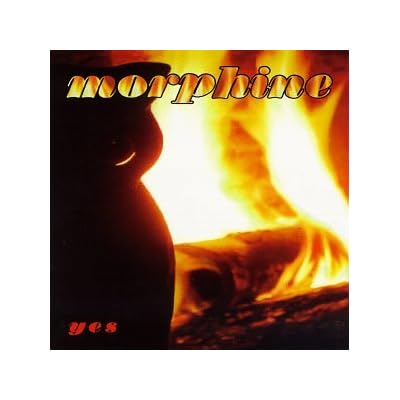
Morphine - Yes

In a rock & roll world divided between guitar bands and synth bands, Morphine exist in a no-man's zone. The Boston trio has neither guitars nor keyboards and gets by with just drums, sax, and bass. In a pop universe where every singer, guitarist, and keyboardist instinctively goes to a higher note to attract attention, Morphine stay hunkered down low. Billy Conway's tuned drum kit, Dana Colley's baritone sax and Mark Sandman's baritone vocals and two-string slide bass all occupy the same low-end band of the sound spectrum. Morphine's odd configuration would have no more than novelty value if Sandman's songs weren't so good. This album's first single, "Honey White," for instance, rides the back of a fast, angular baritone riff to describe a pretty, young girl hooked on drugs. In the dark comedy of Sandman's rock-noir purr, Honey tells her dealer, "You'll get me when I'm old and wizened and not a day before that." He replies, "It won't be that long." The beat and the humor are essential, for otherwise these jazzy, elliptical mood pieces would become unbearably pretentious. The broken relationship described in "Radar" is a pop cliché, but it's given new life by the shattered R&B riff and by the nit-picking bickering of lines like "If I am guilty, so are you. It was March 4, 1982." In similar fashion, modern paranoia and sexual gamesmanship are nailed to the wall in "Sharks" and "Whisper" respectively. --Geoffrey Himes

DL

Bow Gamelan Ensemble

Bow Gamelan Ensemble

Anne Bean
Richard wilson
P.D. Burwell

SIDE 1
1.Water/Iron/Glass/Gas Burners/Water Jets/Motorised Wire Brush/Metal Plate/Caps/Pipes
2.Pyrophones i)Tapped ii)Gas Jets3.Tumble Dryer with Mixed Contents
Side1
4.Motorised Metal Percussion
5.Arc Welder i)Acoustic ii)Electric

SIDE 2
1.Whistling Worm Fan/Bagpipes with Dinghy Pump/Hooters and Horns
2.When I Grow Rich ( Extended Version)
3.Steam Whistles/Blow Torches/Siren
4.3 Solos and 1 Trio

All Compositions © Pulp Music
recorded by Peter Cusack

(1985, Audio Arts Supplement Cassette)

Download Relic

Ali Farka Touré - Savane


DL