Showing posts with label Bach. Show all posts

Monday, November 14, 2011

Yo-Yo Ma - J. S. Bach: The 6 Unaccompanied Cello Suites

Yo-Yo Ma recorded J.S. Bach's Six Unaccompanied Cello Suites on two occasions, first for release on LP in 1983, then again in 1997 on CD. It is the 1983 recording that is presented in Sony's Great Performances line, and the original digital recordings have been processed through direct stream digital to enhance the cello's sound with greater warmth and presence. Ma's readings of Bach are fairly liberal in rhythm and phrasing, and are decidedly more intuitive than analytical, with plenty of rubato and elongation of lines to suggest something like a free Romantic interpretation, far from any Baroque period re-creation. For some listeners who are fans of historically informed or authentic performances of Bach, this may be a stumbling block; but for most, Ma's expressive playing will seem satisfactory and quite enjoyable, if not exactly revelatory. There is a pensive quality to these performances that will strike some listeners as introspective and probing, while others may find them a bit self-indulgent and studied; either way, Ma falls short of ecstatic communion with the music and delivers a technically polished and intelligent performance that has grace and elegance, if not the deepest emotions or visionary heights. Competing with the magnificent recordings by Pablo Casals, Pierre Fournier, and Mstislav Rostropovich, this set can't be regarded as the last word in Bach's Cello Suites; however, it has held its own for many listeners over the years, and it deserves its place in Sony's valued reissue series.
 

Wednesday, October 26, 2011

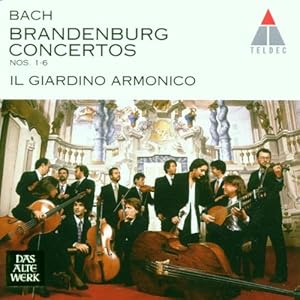
Bach :Il Giardino Armonico - Brandenburg Concertos 1-6

I'm a professional singer who specializes in Baroque and early repertoire. This has made me a firm believer in the historical performance movement. It has done so much to give new shape and dynamism to works that were heretofore rendered mostly in broad, lugubrious strokes. The movement continues to evolve, and as it does the amount of color and depth infusing this repertoire continues to grow and take on new dimension. No longer are many of us content to hear Monteverdi and Lully sung with the extremely bright, straight tones of Emma Kirkby and Nancy Argenta, but rather wish to hear the more appropriate lush and shimmery vocal colors of singers like Sandrine Piau, Guillemette Laurens, Christine Brandeis and Lorraine Hunt Lieberson.

With that in mind, I've heard more recordings of the Brandenburgs than I care to name. And I'm just as tired of the anemic sound and too-fast tempi of ensembles like Hogwood's as I am of the too slow, syrupy interpretations of Furtwangler and Karajan. This recording by Il Giardino Armonico is the only recording I've heard that manages to make these extraordinary works really speak.

Antonini bridges the gap between rich lyricism and crisp articulation better than anyone I can think of who performs this repertoire. My favorite of all the Brandenburgs is #4, and the five-voice fugue in the last movement is the standard by which I judge all the best interpretations of this work. Antonini does the most remarkable things with this piece. The subject is rendered by each voice in the most song-like, tuneful, vocal manner. Instead of thumpy, fast, dry (for most period recordings) or wobbly, incoherent, unintelligible (for most modern instrument recordings) here is great legato playing without any loss of crispness or transparency of texture. Where the line may jump a fifth, he connects the lines where most conductors demand extreme separation, and then creates the most astonishing, perfectly shaped messe di voce you can imagine. That said, all the entrances of the fugue subject are completely distinguishable, and no entrance has the same quality as any other. All the instruments are allowed to let their unique color and texture come forth, and Bach surely understood how important this was when he orchestrated the work. Furthermore, all of the silences in the work are sharply drawn by the ensemble and as dramatic as you might hear in any Beethoven symphony. I could hardly believe what I was hearing, and I was enormously grateful that, finally, someone got it right.

The other great measure of a high-quality period recording of this work is the natural horn playing on the Brandenburg #2. While it's a hair rough and decidedly masculine (the latter not being a bad thing), it's extremely powerful and expressive, and the player (Gabriele Cassone) understands how to make his instrument speak and dazzle, rather than just hammering out a technically perfect performance, which is all that most natural horn players can hope for.

It's rare that I don't have a complaint about a recording, but this is that exception. I recommend this piece heartily and unqualifiedly.A. (amazon review)

Sunday, September 11, 2011

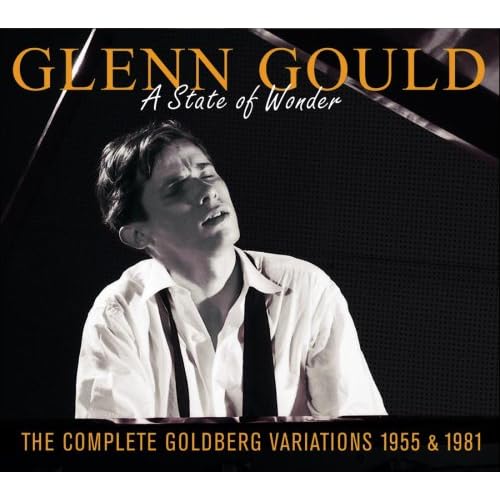
Glenn Gould - A State of Wonder


These two performances of the Goldberg Variations have been reissued so many times. But what makes this new reissue stand out is the bonus interview & outtakes of the 1955 recording sessions, plus all brand new remastered sound using Direct Stream Digital technology, with 2.83 MHz sampling frequency yielding high resolution results on standard CD.
I was a little hesitant to purchase this set at first because I already own both versions of these piece. But after I bought and listened to it, I must say I don't regret it at all.
In 1981, Gould recorded his latest thoughts on the Goldberg Variations. Some people expressed the opinion then that the digital Lp & CD sound was unkindly analytical, lacking timbre, causing the notes to appear disconnected from each other.
Twenty years have passed since Gould's untimely death and to honour him and set the record straight, Sony Music returned to the analogue master tapes made at the same session. In the early 1980's, digital technology was in its infancy and technically imperfect. By contrast, analog technology had reached its peak. As a precaution of early digital imperfection, what many recording companies did, including Sony Music, was running two recording medium simultaneously side-by-side at the recording session and mark analog version as "safety master" in case there's anything wrong with the digital masters. From the technical notes in the booklet of this CD set, when Sony gave the green light to this "State of wonder" project, Sony A&R, reissue producer and two sound engineers as well as a project adviser, Mr. Tim page, made a Digital vs. Analog comparison and they found that the analog safety master has much superior sound that no one had ever heard before. Then the vote was unanimous to reissue the 1981 version using the analog safety master, instead of digital, for the first time after 21 years it was recorded. This analog safety master was unedited, untouched, so they had to acquire the original score marked by Glenn Gould & original records producer, then they edited the tapes to exactly duplicate the sequences chosen for the original release by Glenn himself.
The difference of sound quality is not superficial. Even untrained ears can notice it. Now, there are the sonorities so painfully absent before, providing the necessary connection between the notes. This performance now sings. Well, so does Gould but that becomes an attraction, not a distraction.
The third disc had Gould chatting with Tim Page about the two recordings with illustrations. Also, the never before released 1955 outtakes of Goldbergs' session.
This package is no mere re-exploitation of existing recordings. It does honour to Glenn Gould.

Download

Thursday, September 8, 2011

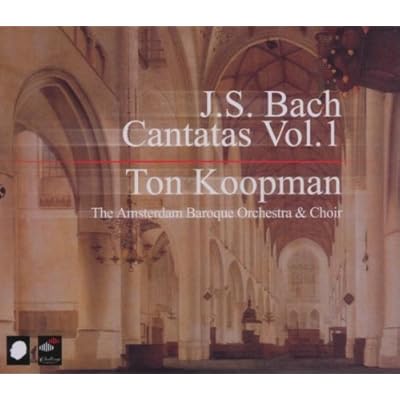
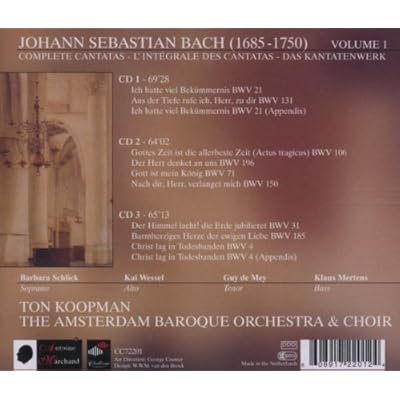
Ton Koopman (The Amsterdam Baroque Orchestra & Choir) - J.S.Bach - Complete Cantatas - Vol.01


Rip and scans from *.ape. Mp3 320 CBR. I have all the 22 volumes and I'm planning of releasing them all.

Johann Sebastian Bach left a magnificent collection of vocal music to posterity.
among which he supposedly included compositions of his own. Certain types of pieces for constantly recurring occasions such as weddings and funerals, as well as settings of frequently used psalms were composed mainly in order to build up a reserve.
Nonetheless, Bach's reasonable hopes were not fulfilled in Mühlhausen, for here too he was only required to compose works for specific events. Cantatas extant from the period up to about 1708 are BWV 4, 71,106,131,150 and 196.
Following his experiences at Arnstadt and Mühlhausen, Bach appears to have lowered his expectations, for his new responsibilities as court organist to the Duke of Weimar did not in any case include vocal composition. The decisive step up, namely from organ and keyboard virtuoso to composer of vocal music for performance, was finally achieved in the spring of 1714, when he was offered the chance to succeed Handel's teacher, Friedrich Wilhelm Zachau, at Halle. Having turned down the post at St Mary's Church with its extensive obligation to provide vocal music, Bach was promoted to Konzertmeister by the Duke. He was also commissioned to compose and perform a new cantata once a month. This resulted in an impressive series of works for voice in which Bach attempted for the first time to take into consideration, as far as possible, every Sunday and holy day in the liturgical year. The existing Weimar repertoire consists of the cantatas BWV 12,18, 21, 31,54,61, 63,132,152, 155,161,162,163,165,172,182 and 199.
Bach's earliest church cantatas are still clearly marked by 17th-century traditions. As well as the influences of older members of the Bach family, those of Buxtehude and Pachelbel the Elder, and Italian and French masters are evident, technically, structurally and stylistically. For example the use of twice the number of violins is of French origin, the treatment of the first violins is Italian, while the motetto concertato choral passages and the inclusion of plainsong and chorale arrangements is German. A particularly characteristic feature of the pre-Leipzig cantatas is Bach's exceptional delight in experimental and complex handling of an extremely wide range of instruments, with refined sound effects (such as the use of the bassoon) and polyand homophonic settings and forms. He painstakingly avoids any standardisation, adopting neither established conventions nor repeating his own solutions and models. Equally noticeable are Bach's many original ideas for making the music reflect the text (e.g. all the voices on a rising scale on the words "leite mich" (lead me) in BWV 150/4) and never previously heard harmonies, especially in cadences (e.g. contrasting the words "Gnade" (mercy) and "Sünde" (sin) in BWV 131/5.).
Before the Weimar period, settings of a mixture of biblical and hymn texts - only occasionally interspersed with freely conceived poetry - predominated.
Thus, musically and formally, each movement has a unified structure, assuring its artistic independence, while flowing coherently one into the other. However, the movements are seldom arranged as self-contained units. At the same time, there is strong emphasis on certain extracts of the text and even on particular words. Only later, with the appearance of the printed cantata libretti of Weimar court poet Salomo Franck, did Bach turn to the modern cantata setting in which individual sections are distinctly separate and types of text are arranged in specific order: recitative and aria, biblical text and chorale. This was to be the definitive musical and textual form of all Bach's subsequent vocal compositions. Likewise, in the area of musical expression, the accent moved from the deliberate differentiation of single words and short textual extracts to a unified spirit binding the whole text.

Download from Uploadstation
Download Part1
Download Part2
Download Part3
Download Part4
Download Part5

Download from Filesonic
Download Part1
Download Part2
Download Part3
Download Part4
Download Part5

Files are interchangeables!!

Use Winrar to unpack.

Tuesday, September 6, 2011

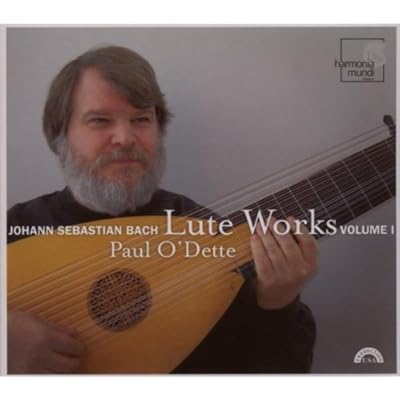
Bach: Lute Works, Vol. 1 - Paul O'Dette


Rip and Scans all done by my original copy. I can provide also FLAC. Ask in the comments.

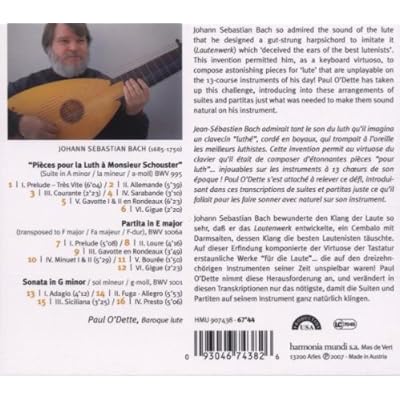
There is a bit of a mystery surrounding Bach's 'lute' music. It simply cannot be played on any standard 13-course lute available in 18th Century Germany. And since he notated his 'lute' pieces in staff keyboard notation and not lute tablature, his intentions are open to interpretation. What Bach may have had in mind requires informed guesswork. If we begin with Bach, himself, any theory must take into account his affinity for abstraction. He could (and did) compose music with no specific instrumentation in mind, The Art of Fugue a prime example. When a specific task or commission is not at stake, he seems to compose music in its absolute sense, leaving musicians to handle performance issues, such as instrumentation, voicings, transposition. 18th Century performers were often jack-of-all-trades, capable of meeting Bach's musical demands, and Bach had no reason to believe that this would change in the future. Another mystery is whether Bach played the lute, himself. Given his universal musical genius, it is likely he knew his way around the instrument without being a virtuoso. There is evidence he gave lute instruction to one of his students, Johann Ludwig Krebs. And he wrote significant lute parts into his St. Matthew and St. John Passions.

What seems to validate the absolute theory is the fact that Bach loved the lute enough to have designed a gut-strung harpsichord, called the Lautenwerk, with a sound that so resembled the lute, it 'deceived the ears of the best lutenists.' Described as the most beautiful of all sounding keyboards, after the organ, because of its ability to emulate the lute, the one complaint was that it was incapable of producing soft and loud sounds as the lute can do. 'It must always be played quickly and arpeggiated as we usually hear skilled lutenists do....' The nature of Bach's 'lute' works indicates that they were composed at the Lautenwerk, a unique instrument, to be played as the performer saw fit.

Paul O'dette uses a 13-course lute by Andrew Rutherford, New York, 2002, after an instrument built by Sebastian Schelle in 1727. He transposes the Pieces pour la luth a Monsieur Schouster, BWV 995 (an arrangement of the C minor Cello Suite, BWV 1011), from G minor to A minor, allowing the piece to be played on a 13-course lute exactly as written. Both of the following 'lute' pieces are Bach reworkings of Partitas and Sonatas for solo violin: the Partita in E major, BWV 1006a (transposed to F major) and the Sonata in G minor, BWV 1001. Bach often played his violin pieces on the clavichord, adding whatever harmonies he thought necessary. The reworkings presumably convinced Bach that there was an abstract harmony not achievable on the violin but possible on the Lautenwerk, with extra bass notes and chords. These found there way into the 'lute' pieces.

O'Dette's playing is elegant and precise, his touch feathery (there is an almost complete absence of noise as he negotiates the strings). His phrasing is impeccable, his use of the lute's wide dynamics serves to articulate each phrase as if emulating the human voice. The more vivacious dances are jaunty and joyful. The inner directed, ruminative movements are soulful, even ethereal, and seem to stop time. Each suite is its own abstract, beautiful world that O'Dette brings to life with nearly flawless technique. His artistry makes this disc, the first volume in an apparent Bach lute series, an important addition to the collections of those who love Bach and the Baroque, and lute and/or string instrument aficionados. The recording sounds warm and clear, with the lute recorded in the middle distance, and nice acoustic reverberation surrounding each note.

This is a splendid recording, worth the investment. Most strongly recommended.

Review by Mark Birman


Download Mp3 320 CBR from Uploadstation
Download booklet scans PDF