Wednesday, December 15, 2010
Tu M' & the Magical Mystery Orchestra (re-up)

Sunday, December 12, 2010
Ornette Coleman - Virgin Beauty
This was introduction to later period Ornette Coleman, and to my ears remains one of his better electric recordings. Ornette and Prime Time really cook up a storm on this release of mostly short numbers. Jerry Garcia (!) from the Grateful Dead even sits in on a couple of selections and feels right at home. The music is well played and loaded with feeling, especially the untitled, mostly solo closing track.Download
Saturday, December 11, 2010
Charles Mingus sextet with Eric Dolphy
Charles Mingus-- ornery, incendiary, and quick-tempered-- was a mountain of a man who produced a mountain of vital music. More than perhaps any other artist, Mingus embodied the past, present and future of jazz all at once, finding the threads that led from the Cotton Club to the avant-garde through everything that came between.
It's a favorite jazzhead pastime to sit around debating which was the best of so-and-so's many bands, and Mingus comes up often in those discussions-- he led bands of every size, shape, and instrumentation over the course of more than three decades. While several of his many masterpieces featured large bands, and he's known as a brilliant composer and arranger with a special gift for texture, he was also one of jazz's greatest bass players and a fine pianist who excelled in small group settings. As to which was his best band, his mid-60s sextet is a serious contender.
The sextet was fairly heavily documented in its day on the stage-- The Great Concert of Charles Mingus, recorded in Paris in April of 1964 and finally reissued in 2004 with the full set list, features this band minus trumpeter Johnny Coles, who was incapacitated at the time with a stomach ailment, and it's one of his strongest recordings. Going back in time a few months from that Paris date, the sextet (Dolphy gets billing on this disc mostly because he was too amazing not to) was coming off a residency at the Five Spot where they honed their interaction and discovered each other's tendencies. They played a one-off show at Cornell, which was lost to the ages until Mingus' widow Sue found a tape.
As a document of the sextet, it's arguably even better than the Great Concert. Unfortunately, there's no mind-blowing version of the latter's "Parkeriana" in this set, but it makes up for that loss elsewhere. For something that was apparently never considered for release, this has pristine recording quality, and it includes all of both sets, nearly filling two CDs with just ten different songs. This set captures the band in an expansive mood, exploring the possibilities of Mingus' ingenious compositions (and a few old favorites as well), and for any fan of 60s jazz, it's a wonder to behold.
The first thing you hear on disc one actually isn't the sextet. It's pianist Jaki Byard playing "ATFW You" (ATFW stands for Art Tatum Fats Waller) on his own to begin the set. The perennially underrated Byard, who was born in the same year as Mingus, 1922, could play deftly in virtually any style. He'd sometimes jump from one idiom to another in the middle of a chorus, stringing together quotes from throughout popular music (such as on this version of "Fables of Faubus" where in his solo he goes from "Yankee Doodle Dandy" to "Lift Every Voice and Sing" to Chopin's "Funeral March" with the ease of someone twirling a radio dial).
Mingus does his own solo thing on Duke Ellington's "Sophisticated Lady". Rock-oriented music fans might hear "five-minute bass solo" and cringe, but this is a truly lyrical reading of the tune that swings effortlessly. The band of Mingus, Coles, Byard, tenor saxophonist Clifford Jordan, drummer Dannie Richmond, and Dolphy on flute, alto sax, and bass clarinet practically plays with one mind on the rest of the tracks, a few of which are truly gargantuan. Their seventeen-minute charge through Billy Strayhorn's "Take the A Train" is like an exploded diagram of the tune, as the band carves it up, the arrangement constantly shifting. Dolphy's trademark extramusical noises make an appearance as he snorts, grunts and audibly breathes his way through the central climax, singing through his sax.
The centerpiece of the entire performance, though, is "Meditations", more commonly known as "Meditations on Integration". The sextet takes you on a half-hour trip through some of Mingus' finest themes, opening with a haunting figure played on arco bass and flute that sounds like something out of a half-remembered dream of Claude Debussy. "So Long Eric", conceived as a temporary goodbye letter for the woodwind player, who had decided to stay in Europe indefinitely after the band's upcoming tour there, would unexpectedly acquire the air of a sad tribute only months later, when Dolphy lapsed into a sudden diabetic coma in Berlin and passed away at the age of 36. The impact of the loss of Dolphy so early is incalculable-- he was a truly original voice on any instrument he touched and cut precious few sessions as a leader.
And that's a part of what made the sextet so special-- it was a band full of distinctive instrumentalists who together made something on the borderline of magic. This set captures them at their finest, still caught in the adventure of learning, but sure enough to make every note count.
— Joe Tangari, August 13, 2007 (Pitchfork)
Sunday, December 5, 2010
Always the same, but a bit different.
Plus: every album has an average download rate of 650 dls, and this is a really big number. Consider that there are pieces which have reached barely the grand total of 100 dls, but happily there are also some that have passed the one thousand mark. This means that 1.000 people from all over the world are now listening to that top quality bootleg from Cecil Taylor, or to an obscure gem of european free improvisation. And this really means a lot to me. The purpose of a blog like this is to share, to make music "promotion", to promote good quality pieces of art and let other aficionados enjoy all of this.
Now I think is time for a giveback.
Nothing will change of course, I promise that in the next months the number of posts will boost increasingly.
But I want to offer a new "service" to the comunity, I wanna give visibility to underground artists.
You have a band, you're doing improvisation/electronics/noises/alternative music on your own? Are you involved in a blasting punk'n'roll band? Enjoy dropping emotional pieces on solo piano? Whatever you do, Jizz is interested in listenings to it and offer you the first page.
Write at: sacco.vanzetti(at)gmail.com
Sunday, June 13, 2010
Pat Metheny & Ornette Coleman - Song X
In what can only be considered a musical perfect storm, Ornette Coleman, Pat Metheny, Charlie Haden, Jack DeJohnette and Denardo Coleman crystallized the Ornette aesthetic into this aural diamond. That stellar rhythm section pushes Coleman and Metheny to nearly explosive levels of intensity. The interlocked (yet somehow completely independent) sax and guitar lines argue, collide, and finally cooperate to produce a defining moment in the careers of both men. Highly recommended.
Reviewer: Mark Saleski
Musicians:
Pat Metheny (guitar), Ornette Coleman (alto sax), Charlie Haden (bass), Jack DeJohnette (drums), Denardo Coleman (drums).
Recorded: Power Station, NYC. December, 1985
More Coleman to come!
Tuesday, June 8, 2010
Nothingface - Violence
This is a really strange album to put up here on jizzrelics. It goes straight in the category "nostalgia". I've started my journey in music with this kind of sounds, all the modern metal shit and so on, late 90s alt-rock. This to me is the best album ever made in that unsung and ready-to-be-forget genre that was nu-metal.
I've uploaded "Violence" just to let you know something more about me.
Download
P.s.: browsing through rapidshare i've discovered that now is possible to convert rapidpoints accumulated with your shared files also in donations to non-profit associations (amnesty international, caritas, wwf...). Jizzrelics made with your downloads a tiny donations of 5.00 euros to amnesty. So thank you, your dls are also useful.
Saturday, February 6, 2010
Braxton / Parker / Graves - Beyond Quantum
An unprecedented free jazz summit meeting of the highest order, Beyond Quantum features composer/multi-instrumentalist Anthony Braxton, percussionist Milford Graves and bassist William Parker in an impromptu blowing session recorded at Bill Laswell's studio.Anthony Braxton has been enjoying a well-deserved resurgence in popularity, courtesy of a growing discography that features collaborations with former students turned rising stars including Taylor Ho Bynum, Mary Halvorson and Jessica Pavone. William Parker has been a galvanizing force in the international scene as key organizer of the Vision Festival, one of today's most important jazz festivals.
In comparison, the legendary Milford Graves is notoriously hermetic. Now a teacher at Bennington College, his days spent supporting Albert Ayler and the New York Art Quartet are long past; he rarely records or plays live. While Braxton and Parker have performed together in the past, this is Graves' first time playing with either, which alone makes this session of historical importance.
The trio operates as a true collective over the course of five lengthy excursions that explore a wide-range of shifting dynamics. Their relentless three-way dialog is a constant evolution of balanced, empathetic interplay.
In a state of continuous flux, Parker and Graves unveil oblique rhythmic patterns that vary in pitch, tone and texture. The woody timbre of Graves' percolating Africanized percussion creates a harmonious polytonal undercurrent for Parker to scatter fragmentary melodic kernels around sparse, well-placed cymbal accents. Parker's elastic phrasing provides Braxton a harmonic anchor for a breathtaking variety of abstract cadences from his arsenal of reeds. Braxton alternates horns frequently, ranging from sopranino to contra-bass saxophones, varying his tonal palette considerably.
Despite this democratic vortex of sound, Braxton often rises above the fray. Free of rigid compositional constraints in this loose, unstructured setting, he sounds inspired as he uncoils a vigorous combination of sinuous and staccato phrases in passages that veer from dolorous tranquility to coruscating frenzy.
Graves and Parker occasionally bring a Pan-African sensibility to the session, which invokes the Sixties-era New Thing. On "Second Meeting" Graves elicits vocal cries reminiscent of the tribal ululations popularized by Leon Thomas. Braxton complies with a mix of squawking sopranino phrases and guttural alto multiphonics while Parker plucks bright tones that recall West African bass patterns. "Fifth Meeting" dispenses with Western harmony and tonality altogether, as Graves' skittering percussion supports a ferocious duet between Braxton's sopranino and Parker's double reeds that culminates in a caterwauling frenzy reminiscent of North African trance music.
All-star free jazz sessions often sound better in theory than they do in execution; this meeting however, sounds timeless. Beyond Quantum is an unexpected and magical recording, a classic destined to top many year end lists. (AAJ)
Download
Wednesday, January 6, 2010
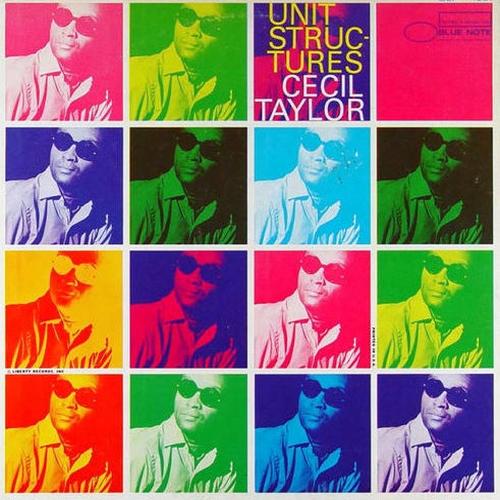
Cecil Taylor - Unit Structures
It woul be a pity start over a new year without at least a new post!
A personal favourite from Cecil Taylor.
- "Steps" – 10:20
- "Enter, Evening" – 11:06
- "Enter, Evening [alternate take]" – 10:11
- "Unit Structure/As of a Now/Section" – 17:47
- "Tales (8 Whisps)" – 7:14
- Eddie Gale Stevens, Jr. – trumpet
- Jimmy Lyons – alto sax
- Ken McIntyre – alto sax, oboe, bass clarinet
- Cecil Taylor – piano, bells
- Henry Grimes – bass
- Alan Silva – bass
- Andrew Cyrille – drums
DL