Sunday, March 13, 2011

Pharoah Sanders - Karma

Although introduced as a protégé of John Coltrane and touted by many as his heir apparent, reedman Pharoah Sanders quickly proved his own man. His shared interest in the "cosmic" music of Coltrane's final period belies the fact that Sanders frequently plays with an unhurried sense of peace and satisfaction rarely found in his mentor's music. His use of space, African and Asian motifs and instruments, and simple, repetitive melodies also pointed the way for jazz, rock, and new age musicians in the '70s and '80s, while his sometimes raucous use of harsh, shrieking runs influenced many of jazz's most adventurous saxophonists.
The centerpiece of Karma is the marathon half-hour octet recording "The Creator Has a Master Plan." Although the track features a warm vocal by Leon Thomas, its true feature artist for almost the entire length is Sanders, who carries the melody, feel, and improvisation firmly on his shoulders. All of Sanders's key elements--Afro-centric spiritualism, sweeping use of mood from long, relaxed intervals to frenetic cacophony, and a deep sense of melody and rhythm--are in evidence. The album's religious feeling is cemented by the album's closer, "Colors," which serves as a deeply felt invocation. --Fred Goodman

Download

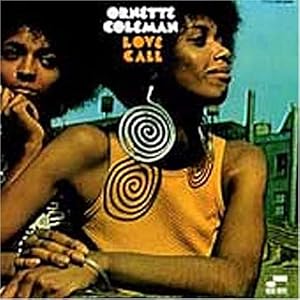
Ornette Coleman - Love Call

I believe the main lesson being taught by Ornette to the world has nothing to do with his "Harmolodic approach". The thing we learn from Coleman is to be ourselves. Here he uses Coltrane's rhythm section, but does not even remotely sound like anything but himself - starting a tune with a short riff, in unison with the tenor of Dewey Redman, then diving into an extended improvisation - playing with few limitations but with pefect control.
The two versions of "Check out time" are an example to Coleman's truly free approach. The opening riff is basically identical, but where on the first version Coleman enters with bursting energy, on the second version the opening is followed by a Redman's long notes over a slowing rhythm. This gives the rest of the piece a whole different feel.
On the Love Call versions Ornette plays trumpet and violin. While I prefer his alto playing, it is good to hear him explore the different sounds and possibilities.
That's Ornette. His mind is always working, unbound by anything other than his own musical sensibilities. He knows his African American tradition - but is not limited by it or any other tradition. It is not easy for a musician to stray from a tradition - it is much easier to stay in the cozy confinements of an existing style/tradition. But the strong survive - as Coleman has. Amazon User

Download

Lucky Thompson - Lucky Strikes


Few musicians are so misnamed as Lucky Thompson, a brilliant tenor and soprano saxophonist who ranked second only to Dexter Gordon as the greatest tenorist to come out of bop before the '50s. Yet Dexter's style was heavily imitated by later generations, making his music much less startling. Lucky sounds like no other player in the music's history. On this album he weaves shimmering, cascading lines on his tenor and soprano over a rhythm section made extraordinarily graceful by the presence of Hank Jones on piano. Richard Davis is good (though he would be better in his modal years on Blue Note) and drummer Connie Kay gives the proceedings an airy athleticism. Thompson's tone on tenor has lightened somewhat since his bebop days (no longer sound indebted to Don Byas) and he was perhaps the first true master of the soprano, playing it with a light yet forceful, vibrato-less tone. His improvisations are remarkably modern. His ideas threaten to fly right off the changes during his wonderfully constructed runs, and his vocabulary studiously omits blues and bop cliches. Those who know his music say he's one of the greatest sax players ever. If you buy this album you'll agree. Amazon User.

Download

Saturday, March 5, 2011

Philly Joe Jones - Showcase


This is a particularly interesting hard bop-oriented set led by drummer Philly Joe Jones. Most unusual is "Gwen," a Jones ballad that has the leader on both piano and (via overdubbing) drums in a trio with bassist Jimmy Garrison. Otherwise, trumpeter Blue Mitchell, trombonist Julian Priester, tenor saxophonist Bill Barron, either Dolo Coker or Sonny Clark on piano, Garrison, and Jones form a sextet that performs modern tunes by Barron, Priester, and Jones, in addition to "I'll Never Be the Same" and Philly Joe's feature on "Gone" (based on the Miles Davis/Gil Evans interpretation of "Porgy and Bess").

Download

Monday, February 28, 2011

Ornette Coleman - At the Golden Circle Vol. 1 & Vol. 2


Maybe it was the supportive European crowd, largely acknowledged as a sympathetic bunch when it comes to American jazz, or the fact that innovator and iconoclast Ornette Coleman , after a two-year hiatus, was in full sprint at the end of 1965. Regardless of the extraneous factors, some of the alto saxophonist's most joyous and musically together moments can be heard among the 15 performances captured at the Golden Circle in Stockholm.

Breathing as one, Coleman's trio with bassist David Izenzon and drummer Charles Moffett manages to converse with a transformed sense of autonomy while simultaneously working within the boundaries of conventional swing.

Tracks like "The Riddle" and "Dee Dee" find Coleman speaking with a sense of unfettered abandon, churning out highly purposeful melodies with apparent ease. "Snowflakes and Sunshine" touts his boisterous and chaotic work on violin and trumpet, while also giving astute listeners some insight as to why guitarist Pat Metheny has called himself largely an "Ornette-styled player." As part of a reissue program remastered by the legendary Rudy Van Gelder , the two separate volumes encompass six previously unissued bonus tracks and deserve to be at the core of any inclusive Ornette Coleman collection.

Download Vol. 1

Download Vol. 2

Grateful Dead - Live Dead


Improvisation had been the Grateful Dead's tie-dyed calling card since their beginnings as the house band for novelist Ken Kesey's mythic mid-60s "acid tests." So, after the fair-to-middling artistic results of their initial three studio-recorded albums, the band opted to release their first-ever concert collection--and irrevocably changed the course of their entire career. Propelled by the epic classic, "Dark Star," as well as folk-tinged "Death Don't Have No Mercy,' and the fusion-ish "The Eleven," Live Dead showcased the instinctual, probing interplay between Jerry Garcia, bassist Phil Lesh, and the rest of the band, and finally captured the Dead's special magic for all to hear. --Billy Altman

Download part 1

Download part 2

Sunday, February 27, 2011

Brian Eno collaborations - Part two

Second part of the ongoing series on Brian Eno.


Brian Eno/John Cale - Wrong Way Up


Both Brian Eno and John Cale have always flirted with conventional pop music throughout their careers, while reserving the right to go off on less accessible experiments, which means they've always held out the promise that they would make something as attractive as this synthesizer-dominated collection, on which Eno comes as close to the mainstream as he has since Another Green World and Cale is as catchy as he's been since Honi Soit. The result is one of the best albums either one has ever made.
Download


Harold Budd/Brian Eno - The Pearl


Hearing Budd's piano slowly fade in with the start of "Late October" is just one of those perfect moments -- it's something very distinctly him, made even more so with Eno's touches and slight echo, and it signals the start of a fine album indeed. Acting in some respects as the understandable counterpart to Ambient 2, with the same sense of hushed, ethereal beauty the partnership brought forth on that album, The Pearl is so ridiculously good it instantly shows up much of the mainstream new age as the gloopy schlock that it often is. Eno himself is sensed as a performer on the album, if not by his absence then by his very understated presence. The merest hints of synth and whisper play around Budd's performances, ensuring the latter takes center stage. Eno and Daniel Lanois handle the production side of things, their teamwork once again overseeing a winner. When they bring themselves a little more to the fore, it still always is in the subtlest of ways, as with the artificially higher-pitched notes from Budd on "Lost in the Humming Air." Part of the distinct charm of the album is how the song titles perfectly capture what the music sounds like -- "A Stream With Bright Fish" is almost self-defining. Another key point is how Budd truly captures what ambience in general can and does mean. "Against the Sky" is a strong example -- it can be totally concentrated upon or left to play as atmospherics and is also at once both truly beautiful and not a little haunting in a disturbing sense. Other highlight tracks include the deceptively simple title track, as serene a piece of music as was ever recorded, and the closing "Still Return," bringing The Pearl to a last peak of beauty.
Download