Download
Thursday, September 29, 2011
Gastr Del Sol - Camoufler
Download
Friday, September 23, 2011
lawrence butch morris - testament a conduction collection

Tuesday, September 13, 2011
nicole mitchell - awakening (2011)Monday, September 12, 2011
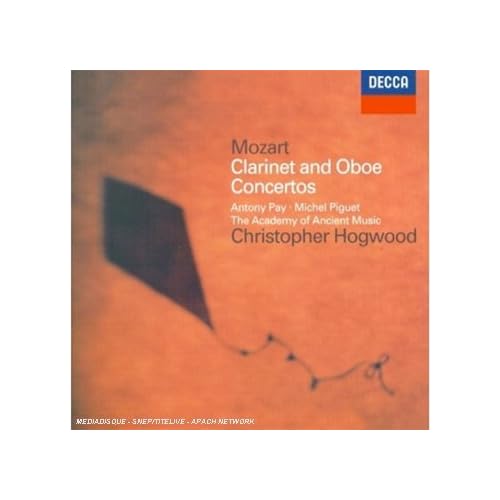
Mozart: Clarinet Concerto / Oboe Concerto -Antony Pay / Michel Piguet / The Academy of Ancient Music / Christopher Hogwood
More often than not, the Oboe Concerto in C is heard in its flute version - transposed to the key of D. This recording presents Mozart's original layout of the oboe concerto played with period instruments or accurate replicas. The bold stability of the key of C major suits the optimism of this concerto, composed in what many call Mozart's mid-period. Fresh yet mature, the language is extremely expressive. The contrast between the three movements goes to the heart of 18th-Century theory on dramatic contrasts - with the confident Allegro, the lyric Adagio and the bouncy Allegretto.
Tempo choice is impeccable. Orchestral textures come across as vibrant and dynamic thanks to the consummate experience of the Academy of Ancient Music, one of the premier Baroque orchestras. But the playing of Michel Piguet is what really sets this performance apart. The sheer fire he puts into the solo makes this music as current and heartfelt as if he really "lived it." His sound is full and expressive, and his choice of cadenzas nothing short of exquisite. The climax to the high "e" in the first movement's cadenza - and the way Piguet reaches it - is delightful.
The Clarinet Concerto brings the listener to another mood - that of Mozart's more somber "third period." Compared to the oboe concerto, the tones are darker, the melodic phrases longer and the counterpoint between the solo and the orchestral voices more complex and pronounced.
One of the important things that sets this CD apart is this. Mozart did not write this piece for a conventional clarinet (in A or Bb) - but for an experimental hybrid instrument capable of extending the clarinet's normal range down to a low and eerie bass register. This instrument, the "Basset Clarinet" was reconstructed for this recording and played masterfully by Anthony Pay.
Thus, the many passages that were transposed an octave higher to suit the modern clarinet (losing most of their dramatic flare) have been restored to their proper pitch - much to the music's advantage. Hear the basset clarinet's "dialogues" between its high and low register, close your eyes and imagine a soprano and a baritone exchanging lines in a sublime opera...
Good choice on continuo playing too. Rather than conducting from the podium as modern conductors do, Hogwood conducts from the harpsichord and the fortepiano respectively. This adds yet more contrast to the different colors of the two concerti - the first brighter, the second rounder and more sedate.
Overall, an excellent CD, that combines great musicological research with expressiveness, fire and passion.
Download
Sunday, September 11, 2011
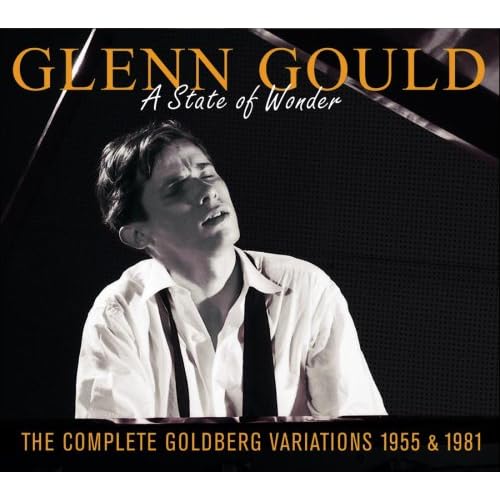
Glenn Gould - A State of Wonder
I was a little hesitant to purchase this set at first because I already own both versions of these piece. But after I bought and listened to it, I must say I don't regret it at all.
In 1981, Gould recorded his latest thoughts on the Goldberg Variations. Some people expressed the opinion then that the digital Lp & CD sound was unkindly analytical, lacking timbre, causing the notes to appear disconnected from each other.
Twenty years have passed since Gould's untimely death and to honour him and set the record straight, Sony Music returned to the analogue master tapes made at the same session. In the early 1980's, digital technology was in its infancy and technically imperfect. By contrast, analog technology had reached its peak. As a precaution of early digital imperfection, what many recording companies did, including Sony Music, was running two recording medium simultaneously side-by-side at the recording session and mark analog version as "safety master" in case there's anything wrong with the digital masters. From the technical notes in the booklet of this CD set, when Sony gave the green light to this "State of wonder" project, Sony A&R, reissue producer and two sound engineers as well as a project adviser, Mr. Tim page, made a Digital vs. Analog comparison and they found that the analog safety master has much superior sound that no one had ever heard before. Then the vote was unanimous to reissue the 1981 version using the analog safety master, instead of digital, for the first time after 21 years it was recorded. This analog safety master was unedited, untouched, so they had to acquire the original score marked by Glenn Gould & original records producer, then they edited the tapes to exactly duplicate the sequences chosen for the original release by Glenn himself.
The difference of sound quality is not superficial. Even untrained ears can notice it. Now, there are the sonorities so painfully absent before, providing the necessary connection between the notes. This performance now sings. Well, so does Gould but that becomes an attraction, not a distraction.
The third disc had Gould chatting with Tim Page about the two recordings with illustrations. Also, the never before released 1955 outtakes of Goldbergs' session.
This package is no mere re-exploitation of existing recordings. It does honour to Glenn Gould.
Download
Spontaneous Music Ensemble - Challenge (Re-post)
Paul Rutherford | John Stevens | Trevir Watts |Kenny Wheeler |Bruce Cale | Jeff Clyne | Chris Cambridge | Evan Parker
1 - E.D.'S MESSAGE - 4:08
2 - 2.B.ORNETTE - 2:07
3 - CLUB 66 - 8:37
4 - DAY OF RECKONING - 8:33
5 - END TO A BEGINNING - 2:42
6 - TRAVELLING TOGETHER - 9:10
7 - LITTLE RED HEAD - 3:52
8 - AFTER LISTENING - 8:10
9 - END TO A BEGINNING - 4:16
10 - DISTANT LITTLE SOUL - 15:13
The discipline of discographical research usually follows a rubric akin to any science-based endeavor in that revision goes part and parcel with the pursuit. Invariably a lost tape or long forgotten reel-to-reel surfaces and succeeds in gumming up the works for those dedicated souls who track musical minutiae and the very idea of the 'complete' recordings of any musician or group is by definition a misnomer. Corroborating the inherent futility in attempting a definitive catalog of a musician or band's every extant recording, Emanem has seen fit to release yet another document from the SME's earliest years, one that has been out of circulation for years and comes newly pressed with a pair of unreleased performances.
Boundaries between free improvisation and free jazz blurred even further back when these tracks were recorded than they do in today's 21st century climate. Many of the pieces in this vintage of the SME songbook have strong jazz referents and it's an exciting prospect to hear them all navigating such jazz-based straits together. The complete sextet sounds off on all but three of the selections with Kenny Wheeler sitting out on two and John Stevens hanging up his sticks on "Little Red Head". Usually working from prearranged heads the band is a tightly knit unit. Sectional interludes of tracks like "Traveling Together" profess a high level of compositional cohesion balanced with individual improvisational verve. The Paul Rutherford-penned fragment "2.B.Ornette" features Wheeler's clipped flugelhorn and delivers fascinating instruction on one of the seminal influences on the group. The opening "E.D.'s Message" references another in its oblique invocation of Dolphy through Trevor Watts' register leaping runs. In similar fashion the saxophonist sails above the bustling firmament of bass and drums on "Club 66", firing off pinched figures and sounding like a personalized amalgam of the aforementioned Coleman and Lee Konitz. Rutherford ranges about the middle register of his brass smearing the edges of his phrases with well-placed plunger manipulations. Stevens practices the rudiments of the economical acumen that was to become his trademark, parsing out press rolls in staccato bursts.
Akin to the prize buried at the bottom of a cereal box the disc's final track offers a smaller assemblage of SME members bringing to life a composition by Stevens. Scripted as an aural encapsulation of the drummer's feelings of homesickness the piece features Watts flighty piccolo in tandem with Evan Parker's nascent soprano. Contemporaneous session photos in the liner notes picture the players bedecked in vests, ties, slacks, and in some instances spectacles looking like youthful Tristanoite intellectuals. The music reflects this academic bent, but is also flavored with a fair amount of visceral thrills. SME discographers may scratch their heads and rush to update their files, but for the rest of us the music is certain to provide satisfaction enough.
Saturday, September 10, 2011
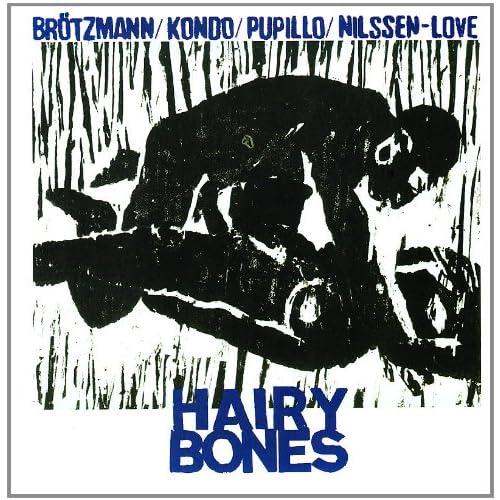
Brotzmann / Kondo / Pupillo / Nilssen-Love - Hairy Bones
Devotees of modern free jazz whose main icon is represented by Last Exit — the quartet of Peter Brotzmann, Bill Laswell, Sonny Sharrock and Ronald Shannon Jackson which repeatedly set the cognoscenti's brain on fire (or, at least, mine...) — could give a try to this, the recording of a performance at Amsterdam's Bimhuis dated September 6, 2008, which features a joint venture between the old guard of Brotzmann himself (alto & tenor sax, Bb clarinet, tarogato) and Kondo (electric trumpet) and younger turks Pupillo (electric bass) and Nilssen-Love (drums).
The record is divided in two extended sections that leave no room for unnecessary reflection, although those who expect a total free-for-all might remain a tad disconcerted, given that the artists not only fuel the activist anger of self-expression with (rather disciplined) fury, but also find the time to reduce the impact of their drive along "calmer" explorations of the partial combination of instrumental voices and dynamics, at times remaining moderately exposed as two or three elements interact. For example, an interesting Pupillo vs. Kondo colloquy in the title track is sandwiched in the muscular antagonism of the group as a whole, and a groovy solo by Nilssen-Love — as distant from the boring percussive marathons of certain "progressive" bands as you can wish — is followed by the drummer depicting shades against the disagreeing stubbornness of Brotzmann, soon aided by the echoing blathering of Kondo until the improvisation reaches its natural demise.
"Chain Dogs" begins with a tense "dissonant lyricism", reed and trumpet emitting pensive notes upon the rhythm section's increasingly mounting inner energy, yet it doesn't take much before the foursome soar again through impatiently clumped rhythmical disorders, aggravating the dynamic conflict by the minute, Brotzmann emitting autistic ostinatos amidst fuming devastations by Pupillo and Nilssen-Love, Kondo attributing a spacey vibe to the jumble via modified reverberations of his tool. The music gradually becomes a cross of intimidation and unalterable faith in some sort of divine light leading the sonic splodge out of potential holes, as what appears tempestuous at first reveals instead a logic of coherence which facilitates the approach to the listening experience, and the quieter sections hide nonetheless the peril of a venomous sting.
Forget the cerebral aspects and be overwhelmed by the threatening physicality of this set. Hairy Bones is a classic case of "play-loud-neighbors-be-damned" outing, an exhibition of conspicuous skill in the thick of apparent mayhem.
Download from Wupload
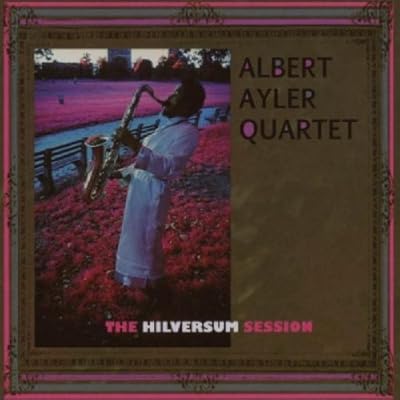
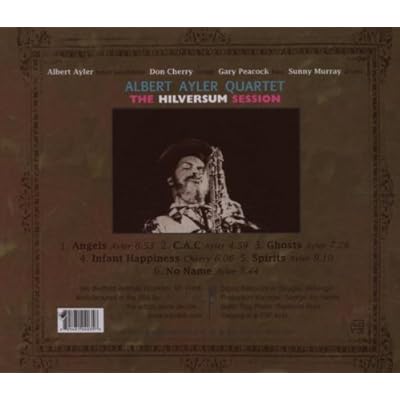
Albert Ayler Quartet - Hilversum Session
Download